

You know you need a cyber security strategy. What you probably do not know is whether what you have actually qualifies as one.
You have the tools. Antivirus. A firewall. Maybe two-factor authentication on email. What you do not have is something connecting those tools into a structure that holds under pressure.
Something with a spine.
In 23 years of working with businesses across regional Queensland, that is the gap I see more than any other. Not ignorance. Not negligence. Just parts, with nothing holding them together.
A cyber security strategy is that spine and this is what building one actually looks like.
What Does a Strong Cyber Security Strategy Actually Include for a Small Business?
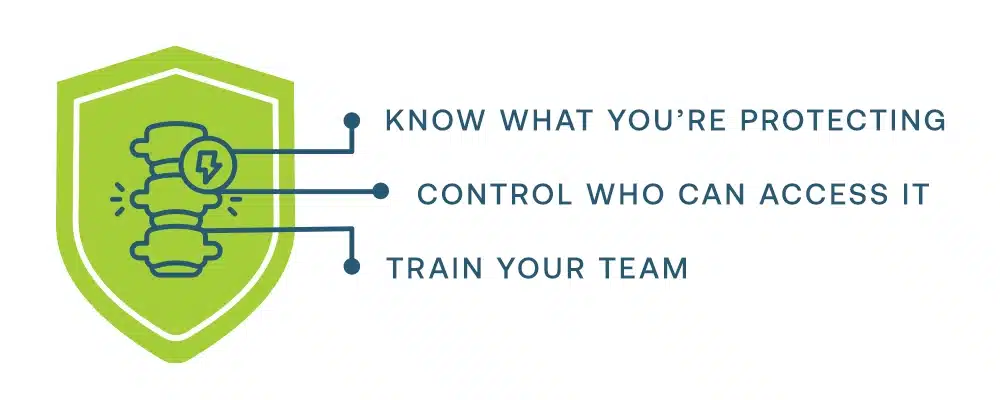
A strong cyber security strategy covers four things. Knowing what you are protecting, controlling who can access it, training your team to behave safely, and monitoring your systems so problems surface early.
Think of a spine as each of its individual vertebrae, all connected and load-bearing. Miss just one and the whole structure comes falling down. A strong cyber security strategy works the same way. Strong vertebrae, each one essential, each one load-bearing.
The 4 vertebrae of a strong strategy:
- Knowing what you are protecting.
- Controlling who can access it.
- Making sure your team knows how to behave safely.
- Having eyes on your systems so problems surface early, not after the damage is done.
Partial coverage across all four does not add up to a complete picture. It does not. Gaps between controls are where breaches happen. A product-by-product approach creates exactly the kind of uneven coverage that makes those gaps easy to find.
A cyber security strategy is what connects those vertebrae. When they are aligned, the structure holds. When they are not, you are one bad day away from finding out which one was missing.
It took a letter from a regulator.
A Cairns financial advice firm received a notification from their industry regulator outlining the risks of unmanaged devices. When they reviewed their existing setup, they found potential legal exposure under the Australian Privacy Principles and gaps they had not known were there. They came to Future IT not with a list of products they wanted, but with a problem they needed solved. Within weeks they had a structured strategy, Essential Eight Maturity Level 2 compliance, and a clear picture of exactly what they were protecting and why.
Where Does a Small Business Actually Start When Building a Cyber Security Strategy?
Start by mapping the data and systems your business cannot afford to lose or expose, before you look at any product or policy.
Before any product or policy, map the data and systems your business genuinely cannot afford to lose or expose. For a professional services firm in Cairns, that is usually client files, financial records, and your email system. For a nonprofit managing grant funding, it is donor records and compliance documentation. For an Aboriginal Medical Service, it is patient data and the clinical systems supporting care delivery.
That is your spine’s foundation. You cannot build structure on top of nothing.
A good starting point is the Essential Eight, a set of practical controls developed by the Australian Signals Directorate for Australian organisations.
How Does Staff Awareness Fit Into a Small Business Cyber Security Strategy?
Staff awareness is the most significant variable in whether your strategy holds. Most successful attacks do not start with a technical exploit. They start with a person.
It is the vertebra that gets left out.
Not because of negligence. Because it does not feel like a technical problem. It feels like a people problem, and people problems are harder to buy your way out of.
Attackers know this. They do not target your firewall. They target the person who clicks the link that looks like it came from your bank, or enters their credentials on a login page that is one letter off from the real thing.
If your team cannot identify a phishing attempt, does not know what to do when something feels off, or is reusing the same password across systems, the best tools in the world will not cover that gap. Future IT cyber security training is built around making this practical for the people actually sitting at your desks, not just whoever has IT in their job title.

How Do You Know If You Have a Cyber Security Strategy or Just a Collection of Products?
If you cannot explain what your business is protecting and why, you have products, not a strategy.
Here is the test. If you pulled the spine out, stripped away every tool, every licence, everything you are currently paying for. Would anything fall?
If the answer is yes, you have products. Not a strategy.
You buy a tool when someone recommends it. You renew the licence every year because it feels responsible. Over time you accumulate protections that overlap in some areas and leave gaps in others, with nobody quite sure what each piece does or whether the whole picture holds together. Attackers look for those gaps. A product-by-product approach creates exactly the kind of uneven coverage that makes them easy to find.
What Are the Signs That a Small Business Needs a Proper Cyber Security Strategy?
You are operating reactively if your team does not know what to do when something looks suspicious, you have never tested your backups, or you bought security tools after an incident rather than before one.
You are probably waiting rather than deciding if any of these sound familiar. Your team does not know what to do when an email looks suspicious. You bought a security product after something went wrong, not before. Your backups have never actually been tested. You have just assumed they would work.
Any of those sound familiar?
None of that makes your business unusual. The issue is that normalising it makes the cost invisible, right up until it is not.
What Does Putting a Cyber Security Strategy Into Practice Actually Look Like?
It starts with a conversation about your business, not your systems. What do you have? Who has access to what? What would a genuinely bad day look like, specifically for you?
The attack came during the build.
An Aboriginal Medical Service in North West Queensland had watched a peer organisation suffer a data breach. They knew the threat was real. What they did not have was a structure they could trust to hold.
Future IT reviewed their environment, identified the gaps, and recommended Essential Eight Maturity Level 2, the highest level achievable within a three-month window. They reached it without a single service interruption. During the process, the newly built structure blocked an attempted attack before it could cause damage.
“We can rest easy knowing that our patients’ data and sensitive information are as safe as can be.” — Gidgee Healing
That is what a spine does. It holds.
A solid foundational strategy does not take months. It takes a few focused weeks and someone who has done it before. And it needs to move when your business does — new staff, a new location, a near-miss. The Future IT human risk report gives you that periodic read so your strategy stays current rather than just historical.
The Bottom Line
A cyber security strategy is not a project you complete. It is the spine you build, maintain, and rely on when something hits.
The businesses that have one stand up straight under pressure. The ones that are still waiting find out what happens when the parts do not hold together.
If you are not sure whether what you have qualifies as a spine, Future IT cyber security services work with businesses across Cairns, Townsville, and regional Queensland to build strategies that are proportionate, practical, and built to hold.